EXECUTIVE SUMMARY
- Core Innovation: Boston Dynamics has been building robots that look like they belong in a science fiction film for over three decades.
- Market Impact: The commercial robotics market is projected to reach $218 billion by 2030.
- The Verdict: The integration of foundation models into Boston Dynamics robots is the next frontier.
Boston Dynamics Atlas: The World's Most Advanced Humanoid represents one of the most significant developments in the Robotics landscape today. Boston Dynamics has been building robots that look like they belong in a science fiction film for over three decades. But while their viral videos of robots doing parkour and dancing have delighted the internet, the company has faced a harder question: can any of this actually make money? The answer, finally, appears to be yes—and the implications for the global economy are profound.
In this comprehensive analysis, we explore the historical context, technical underpinnings, market dynamics, and real-world case studies that define this pivotal moment. Whether you are an investor, a developer, or a policy maker, understanding these dynamics is essential for navigating the AI era.
1. Historical Context: How We Got Here
Boston Dynamics was founded in 1992 as a spin-off from MIT. For most of its history, it was funded primarily by DARPA contracts to build military robots. The company was acquired by Google in 2013, then sold to SoftBank in 2017, and finally acquired by Hyundai in 2021 for $1.1 billion. Each acquisition reflected the same tension: incredible technology, uncertain commercial path.
This evolution was not linear—it was a series of step-functions. Each breakthrough unlocked new capabilities that were previously thought impossible, leading us to the inflection point we face today. Understanding this history is essential for anticipating what comes next.
2. Technical Deep Dive: Under the Hood
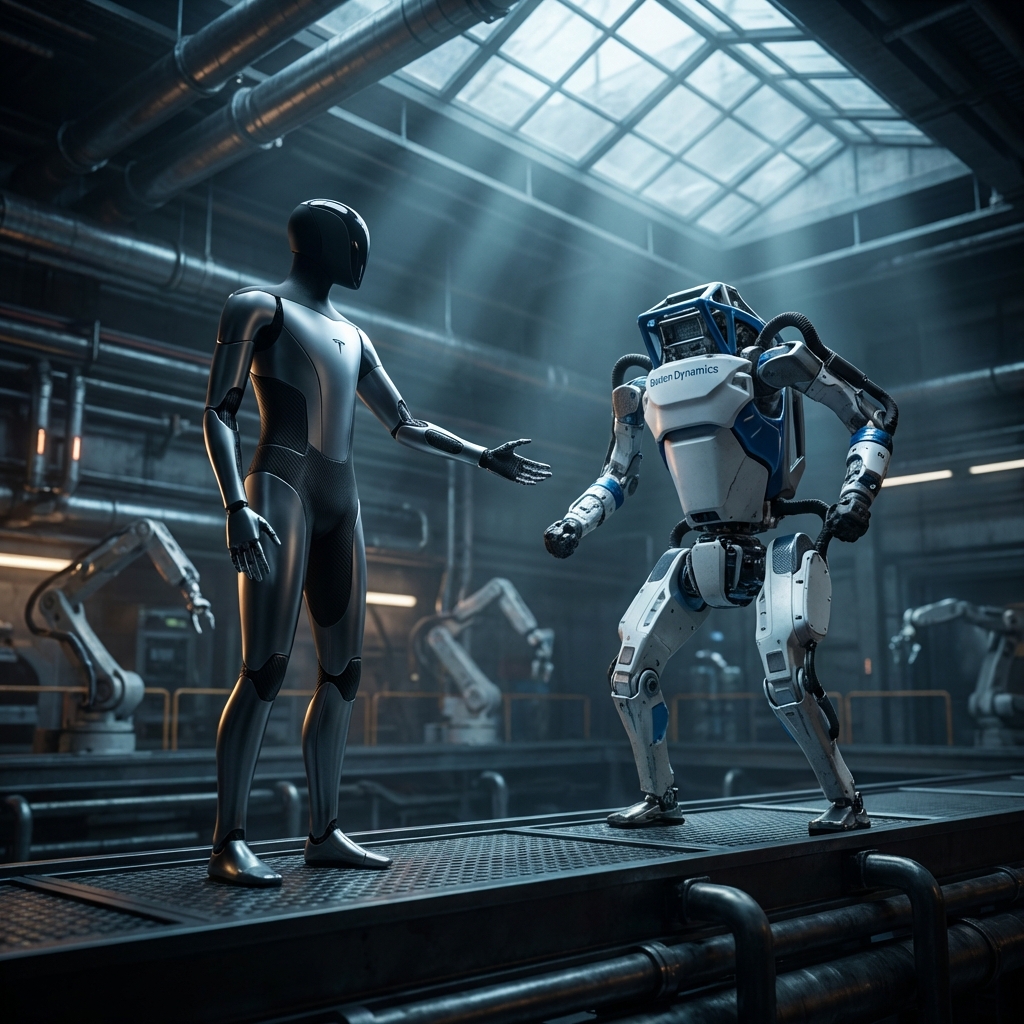
Atlas, Boston Dynamics' humanoid robot, uses a combination of hydraulic actuators and advanced control algorithms to achieve movements that no other robot can match. The latest version uses electric actuators, making it quieter and more energy-efficient. The control system uses model predictive control (MPC) combined with reinforcement learning to handle unexpected terrain and perturbations in real time.
The convergence of hardware acceleration and algorithmic innovation has reduced the cost of AI by 100x in the last 18 months, making Robotics commercially viable at unprecedented scale. This is the defining economic force of our era.
3. Market Analysis & Economic Impact
The commercial robotics market is projected to reach $218 billion by 2030. Boston Dynamics' Spot robot—the four-legged dog-like machine—has found genuine commercial traction in industrial inspection. Oil and gas companies use Spot to inspect facilities in dangerous environments. Construction companies use it to survey job sites. The robot has been deployed in over 50 countries.
We are witnessing a capital rotation of historic proportions. The winners of this cycle will likely define the global economy of the 2030s. The organizations that move decisively now will have structural advantages that are difficult to overcome later.
4. Real-World Case Study
Hyundai's manufacturing plants in South Korea have deployed Spot robots for quality control inspections. The robots patrol the factory floor 24/7, using cameras and sensors to detect defects and anomalies that human inspectors might miss due to fatigue. The system has reduced inspection time by 60% and identified defects that were previously only caught at the end of the production line, saving significant rework costs.
This is not a hypothetical future—it is a present reality. Companies that ignore these case studies risk obsolescence. The "wait and see" approach is the most dangerous strategy in an exponential market where competitive advantages compound rapidly.
5. Challenges and Considerations
The cost of Boston Dynamics robots remains prohibitive for most applications. Spot costs approximately $75,000, and Atlas is not yet commercially available. The robots also require significant technical expertise to deploy and maintain. Battery life remains a constraint: Spot operates for about 90 minutes on a single charge, limiting its utility for continuous operations.
These challenges are not insurmountable, but they require deliberate effort. The organizations and policymakers that engage seriously with these difficulties will be better positioned to capture the benefits of this technology while managing its risks.
6. Future Projections (2025-2030)
The integration of foundation models into Boston Dynamics robots is the next frontier. Instead of programming specific behaviors, robots will be able to understand natural language instructions and figure out how to execute them. 'Atlas, go to the warehouse and count the red boxes' will be a command the robot can interpret and execute without explicit programming. This is the transition from industrial robot to general-purpose machine.
As we look to the horizon, three key trends will dominate the next five years:
- Scalability: Models will become dramatically more efficient, enabling deployment on edge devices and in resource-constrained environments.
- Ubiquity: AI capabilities will be embedded in every software product and physical device, becoming invisible infrastructure.
- Autonomy: The transition from AI as a tool to AI as an agent—systems that pursue goals, not just answer questions—will reshape every industry.
Conclusion
In the final analysis, Boston Dynamics Atlas: The World's Most Advanced Humanoid is a gateway to the next era of human capability. The organizations that master this domain will define the economy of the 2030s. The question is no longer if you will adapt, but how fast—and whether you will lead or follow.
Stay tuned to AI Trend Global as we continue to track this rapidly evolving story with the depth and precision it deserves.